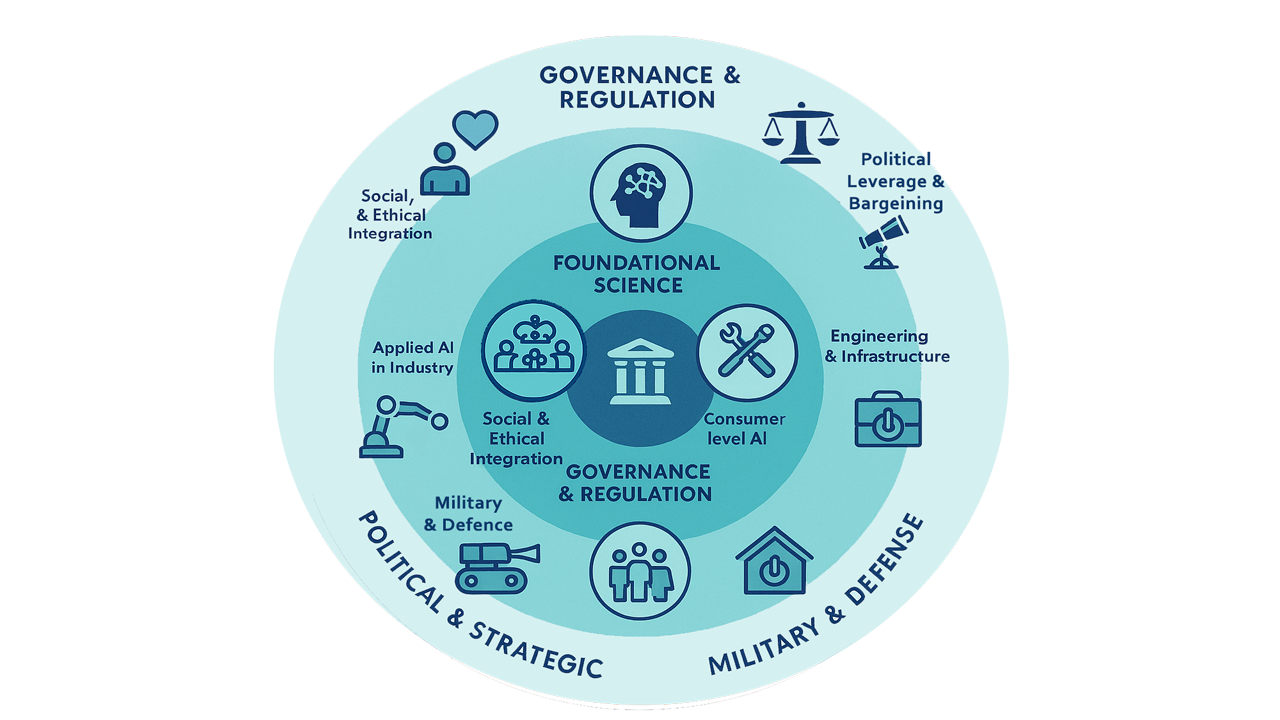
The Multilevel Structure of AI Involvement in Society
Dear reader,
AI is advancing fast and our institutions are struggling to keep up, creating real uncertainty and growing public concern. This article gives a clear, practical map that links how AI systems work to the real-world problems they can cause, so you can spot risks early and act with confidence.
Read it to make better decisions under pressure, to advocate for the right safeguards, and to avoid being surprised by developments that can reshape markets, public trust, and people’s rights.
Contents
- Where Intelligence Begins: The Science Behind AI
- Engineering & Infrastructure
- Applied AI in Industry
- Consumer-Level AI
- Governance & Regulation
- Social & Ethical Integration
- Recursive AI Development
- Political Leverage & Strategic Bargaining
- Military & Defense AI
 Where Intelligence Begins: The Science Behind AI
What it is: The theoretical and mathematical bedrock of artificial intelligence.
Key domains:
- Machine learning theory
- Neural network architecture
- Computational neuroscience
- Cognitive modeling
- Symbolic reasoning and logic
Institutions: MIT, Stanford, Max Planck Institute, DeepMind, OpenAI
Purpose: To understand intelligence itself—how it can be modeled, learned, and replicated.
Artificial Intelligence begins not with machines, but with mathematics, logic, and the study of cognition. Before algorithms can act, they must be conceived—and that conception happens in the realm of foundational science. This article explores the deep roots of AI theory, the disciplines that shape it, and why understanding these foundations is essential for grasping the entire AI ecosystem.
Overview
Foundational science is the conceptual core of artificial intelligence. It produces the theories, mathematical frameworks, and experimental methods that let us reason about learning, representation, decision making, and intelligence itself. Work at this level is not about shipping products; it is about discovering which models can generalize reliably, why certain training procedures converge, and how to formalize concepts like causality, uncertainty, and representation. Strong foundational science gives engineering predictable primitives to build on and provides the vocabulary for evaluating risk, trust, and limitations.
Learning Theory and Generalization
Learning theory asks why and when algorithms trained on examples succeed on new, unseen data. It develops bounds, complexity measures, and formal guarantees that help predict overfitting, sample efficiency, and robustness. Practical outcomes include techniques for regularization, domain adaptation, and distribution-shift detection. Current challenges include deriving realistic generalization guarantees for large, overparameterized networks and building theories that explain transfer learning across very different tasks.
Representation and Architecture
How information is represented inside a model shapes everything it can do. Research here compares symbolic, connectionist, and hybrid approaches; studies inductive biases embedded in architectures; and designs modules that encode structure—graphs for relations, attention for variable coupling, equivariant layers for symmetry. Advances in architecture can suddenly change what models learn from the same data, making this layer both powerful and fragile: small architectural shifts can produce large behavioral differences.
Optimization and Training Dynamics
Optimization research studies the dynamics by which models acquire competence: loss landscapes, gradient behavior, implicit biases of optimizers, and the role of initialization and curriculum. These studies explain why some training runs converge to robust solutions while others discover brittle shortcuts. Better understanding of optimization dynamics enables more predictable training schedules, reduced compute waste, and safer mechanisms for preventing degenerate behaviors.
Probabilistic Reasoning and Causality
Models that only learn statistical correlations are limited in transferability and robustness. Probabilistic reasoning and causal inference provide tools to distinguish correlation from mechanism, to reason under uncertainty, and to plan interventions. Foundational work in this area produces algorithms for counterfactual reasoning, causal discovery, and uncertainty quantification—capabilities essential for safety-critical systems and trustworthy explanations.
Cognitive Modeling and Neuroscience Inspirations
Cognitive modeling and computational neuroscience translate ideas about perception, memory, attention, and decision-making from biological systems into computational hypotheses. This cross-talk yields architectures and learning rules inspired by brains, and it helps identify which cognitive capacities are necessary for general intelligence. The relationship is two-way: computational models suggest experiments for neuroscience, and neural data refines model assumptions.
Formal Methods and Verification
Formal methods aim to provide provable guarantees about system behavior: safety properties, invariants, and correctness of critical routines. Techniques include model checking, theorem proving, and specification synthesis. While full formal verification is often infeasible for large neural systems, hybrid approaches—certified components, bounded guarantees, and formally verified training pipelines—are practical ways to raise the bar for high-risk applications.
Benchmarks, Datasets, and Measurement
Foundational work also builds the measurement apparatus of the field: benchmarks that stress specific capabilities, datasets that represent realistic distributions, and evaluation methodologies that quantify robustness, fairness, and alignment. Good benchmarks illuminate weaknesses; poor benchmarks reward brittleness. Creating representative, adversarially aware, and ethically curated evaluation sets is a persistent and necessary challenge.
Open Problems and Ethical Implications
Key open problems include understanding emergent capabilities, preventing mesa-optimization, quantifying and controlling distributional shift, and defining socially meaningful evaluation criteria. Foundational science must also integrate ethical reasoning: it should surface value-laden tradeoffs, make normative assumptions explicit, and provide tools that let engineers measure social impact. Without this integration, technical advances risk amplifying harms even if they succeed at narrow benchmarks.
Why Readers Should Care
Foundational science determines the ceiling of what engineered AI can safely do. It shapes which capabilities will be reliable, which failure modes are plausible, and which regulatory or oversight strategies are meaningful. For readers trying to understand AI’s long-term trajectory, grappling with these foundations is not optional: it clarifies why certain policies are necessary, why some promised fixes are unlikely to work, and where real leverage exists to make AI both powerful and safe.
Key Disciplines:
- Machine Learning Theory: How systems learn from data and improve over time.
- Neural Network Architecture: Inspired by biological brains, these models simulate learning and pattern recognition.
- Computational Neuroscience: Studies how biological intelligence can be modeled computationally.
- Cognitive Modeling: Simulates human thought processes to inform AI design.
- Symbolic Reasoning & Logic: Enables rule-based systems and formal decision-making.
Who Shapes This Field?
Foundational AI science is driven by:
- Academic Institutions: MIT, Stanford, Max Planck Institute
- Research Labs: DeepMind, OpenAI, FAIR (Meta AI)
- Scientific Journals: NeurIPS, JMLR, Nature Machine Intelligence
These entities publish breakthroughs, define terminology, and set the pace for innovation.
Why It Matters
Without foundational science:
- AI systems would lack structure, interpretability, and reliability.
- Ethical debates (like alignment or bias) would be ungrounded.
- Regulation would be reactive, not proactive.
Understanding the science behind AI is like knowing the blueprint before building the house.
 Engineering & Infrastructure
What it is: The technical scaffolding that turns theory into functioning systems.
Key components:
- Data systems — collection, labeling, validation, versioning, and storage that determine model behavior and bias.
- Compute and hardware — GPUs, TPUs, clusters, and edge devices that set feasibility, cost, and latency constraints.
- Training pipelines — automated, config-driven workflows for preprocessing, experiments, checkpointing, and reproducibility.
- Model serving and deployment — APIs, inference servers, edge provisioning, canary releases, and rollback mechanisms for safe production rollouts.
- Monitoring and observability — continuous metrics, drift detection, logging, and alerting to catch degradation and emergent failures early.
- Reliability and safety controls — input sanitization, confidence thresholds, rejection policies, human-in-the-loop fallbacks, and chaos testing.
- Governance and auditability — access controls, audit logs, signed artifacts, and reproducible builds for accountability and incident tracing.
- Tooling and ecosystem — frameworks, feature stores, experiment trackers, and orchestration (e.g., Kubernetes) that standardize best practices.
Outcome: well-engineered infrastructure produces reproducible, efficient, and maintainable AI systems that scale safely into production while reducing silent failures, enabling accountability, and lowering the real-world risk of harmful behavior.
Overview
Engineering and infrastructure are the practical layer that turns AI theory into reliable, scalable systems. This domain covers everything from how raw data is collected and maintained to how models are trained, deployed, observed in production, and governed. Good engineering converts experimental models into repeatable artifacts with predictable behaviors; poor engineering hides brittleness and amplifies risk when systems interact with the real world. The work is inherently interdisciplinary, combining software engineering, systems design, data engineering, and operational rigor.
Data Foundations
High-quality data engineering is the foundation of dependable AI. It begins with disciplined collection and curation practices that preserve provenance, lineage, and representativeness, and continues through annotation, validation, and ongoing refresh strategies that reduce drift. Data schemas, versioning, and automated validation pipelines make it possible to reproduce experiments and trace the source of model behavior. When data is treated as a first-class engineering artifact, teams can reason about bias, coverage gaps, and distributional shifts rather than react to them after deployment.
Training Pipelines and Optimization
Training pipelines are the reproducible workflows that transform datasets and model definitions into trained artifacts. These pipelines encode preprocessing, augmentation, experiment configuration, hyperparameter sweeps, checkpointing, and artifact storage so runs can be audited and rolled back. Understanding optimization dynamics and training stability is part of this layer: monitoring loss landscapes, debugging gradient issues, and designing curricula or regularizers that prevent shortcut learning. Robust pipelines reduce wasted compute, make comparisons meaningful, and limit the surprise factor when models are promoted to production.
Compute Deployment and Serving
Engineering choices about compute and deployment determine what models are feasible and how they behave for end users. Hardware selection—from GPU clusters to edge accelerators—shapes training time, cost, and latency tradeoffs. Deployment architecture defines how models are served, how updates are rolled out, and how capacity scales under load, using techniques such as canary releases, blue-green deployments, and versioned APIs. Effective deployment strategies ensure predictable latency, graceful degradation, and clear rollback paths when a new model performs unexpectedly.
Monitoring Safety and Reliability
Observability is the mechanism that turns deployed models from black boxes into manageable services. Continuous monitoring of input distributions, performance metrics, and downstream user impact reveals drift, regression, and emergent failure modes before they escalate. Safety controls such as input sanitization, calibrated confidence thresholds, rejection or fallback policies, and human-in-the-loop review reduce the chance that the model’s output causes harm. Reliability testing—shadowing, end-to-end integration tests, and chaos experiments—validates that the whole stack, not just the model, tolerates real-world faults.
Governance Tooling and Outcome
Governance and tooling close the loop between technical practice and accountability. Access controls, audit logs, reproducible builds, signed artifacts, and experiment tracking provide the records needed for audits, incident investigations, and regulatory compliance. Shared frameworks, feature stores, orchestration platforms, and standardized SDKs raise the baseline for safe practice across teams. The outcome of disciplined engineering and infrastructure is not merely functioning AI: it is reproducible, explainable, and maintainable systems that scale while minimizing silent failures, enabling responsible oversight, and lowering the real-world risk of harmful behavior.
 Applied AI in Industry
What it is: AI embedded in sector-specific workflows.
Domains:
- Healthcare: diagnostics, drug discovery
- Finance: fraud detection, algorithmic trading
- Logistics: route optimization, demand forecasting
- Education: adaptive learning platforms
- Agriculture: crop monitoring, yield prediction
Impact: Efficiency, cost savings, predictive power
Planning structure for Applied AI in Industry
The user wants two texts: a basic description followed by a deeper overview with simpler structure. They previously asked for this format for Engineering, so I'll apply the same for Applied AI in Industry. I'll start with a concise description in one paragraph, followed by a deeper overview with numbered subsections. I’ll stick to simple, clear structure without redundancy, focusing on clarity and brevity. I'll keep to six sections, following the development rules, and use short paragraphs with clear headings to keep everything organized. Let's get started!
Overview
Applied AI in industry turns research and engineered models into domain-specific solutions that automate tasks, augment human decision-making, and create new products and services. Companies integrate AI into clinical diagnostics, financial risk systems, supply-chain optimization, customer service, and creative tools, adapting models to domain constraints, regulatory requirements, and operational workflows. Success depends on translating abstract capabilities into measurable business value while managing dataset limitations, deployment realities, and human workflows that consume and validate model outputs. Applied AI projects are judged by their operational reliability, measurable ROI, and the degree to which they reduce human workload, improve outcomes, or unlock new capabilities.
Problem Framing and Domain Knowledge
Applied projects begin by converting a business or operational need into a well-defined ML problem. This requires close collaboration with domain experts to articulate objectives, success metrics, acceptable failure modes, and constraints such as latency, privacy, or compliance. Clear framing avoids wasted experimentation and aligns model outputs with real decision processes.
Data Engineering for the Domain
Domain datasets are collected, labeled, and curated with an emphasis on representativeness and edge cases that matter in practice. Effective pipelines record provenance, class balance, and annotation quality, and include procedures for continuous data refresh and feedback loops from production to training datasets.
Model Selection and Adaptation
Choice of model is driven by capability needs, interpretability requirements, and resource constraints. Teams adapt pre-trained foundations, fine-tune for domain specifics, or design hybrid systems that combine rules and learned components. Practical adaptation focuses on robustness to domain shift and minimizing brittle shortcuts.
Validation and Risk Assessment
Validation combines standard metrics with domain-specific tests, stress scenarios, and adversarial cases. Risk assessments identify downstream harms, cascading failures, and privacy leaks, and translate these risks into mitigation strategies such as conservative thresholds, human review, or staged rollouts.
Integration with Business Processes
Deployed AI must fit into human workflows and operational systems: dashboards, approval queues, automated pipelines, or embedded agents. Integration includes UI/UX design for decision support, clear provenance traces for model outputs, and defined escalation paths when outputs are uncertain or contested.
Deployment and Operationalization
Productionization covers model serving, scaling, latency optimization, versioning, and safe update patterns. Canarying, shadow deployments, and progressive exposure limit blast radius from regressions. Operationalization also includes cost engineering to balance model size, throughput, and infrastructure expenses.
Monitoring, Feedback, and Continuous Improvement
Post-deployment monitoring tracks performance, user impact, input drift, and fairness metrics. Feedback loops capture real-world errors and label corrections that feed retraining cycles. Continuous improvement balances rapid iteration with safety checks to avoid deploying harmful regressions.
Compliance, Ethics, and Stakeholder Communication
Applied AI must navigate regulatory regimes, industry standards, and stakeholder expectations. Documentation, impact assessments, and explainability artifacts support audits and customer trust. Transparent communication about limitations and a clear owner for AI-driven decisions are essential governance practices.
Measured Outcomes and Long-Term Value
Mature applied AI delivers measurable outcomes: reduced error rates, cost savings, faster throughput, better customer retention, or improved clinical outcomes. Long-term value comes from embedding AI into repeatable systems, capturing institutional learning, and maintaining technical debt under control so models remain useful and safe over time.
 Consumer-Level AI
What it is: AI in everyday life—often invisible but deeply influential.
Interfaces:
- Smartphones (voice assistants, camera filters)
- Smart homes (thermostats, lighting)
- Recommendation engines (YouTube, Netflix, Amazon)
- Social media algorithms
Risks: Surveillance, manipulation, addiction, bias
Overview
Consumer-level AI is the layer of artificial intelligence that touches everyday life through products and interfaces: voice assistants that schedule meetings, recommendation engines that shape what we watch and buy, camera features that enhance photos, and smart-home systems that adjust lighting and temperature. These systems are designed for scale and latency, optimized for user experience, and often operate with limited transparency about data use or decision logic. Their primary goals are convenience, personalization, and engagement, but they also introduce risks such as behavioral manipulation, privacy erosion, amplification of bias, and attention capture. Understanding consumer AI requires looking at how models are embedded in interfaces, how business incentives shape design, and how feedback loops between users and algorithms change behavior over time.
Interface and Interaction Patterns
Consumer AI is realized through interaction layers: conversational agents, recommendation widgets, camera aides, and embedded assistants in apps and devices. Design choices—turn-by-turn dialogue, push notifications, autoplay—determine how aggressively the system intervenes in a user’s attention and decisions. Usability tradeoffs shape acceptance but also the potential for coercive or addictive patterns.
Personalization and Profiling
To provide relevance, consumer AI builds profiles from user behavior, preferences, and inferred attributes. These profiles enable personalization but create concentration of sensitive inferences and opaque decision logic. Personalization improves short-term engagement while potentially narrowing exposure and reinforcing existing biases.
Data Practices and Privacy
Consumer systems rely on continuous telemetry: interaction logs, sensors, location, and device signals. Data pipelines often aggregate, anonymize imperfectly, and feed both product improvement and monetization channels. Privacy risk arises from overcollection, inadequate minimization, or cross-context linking of data that users did not expect to be combined.
Business Models and Incentives
Ad-driven and engagement-maximizing business models bias product design toward attention retention and click optimization. Subscription or device-led models can prioritize convenience and trust differently. Business incentives determine what safety measures are implemented, what tradeoffs are accepted, and how transparently limitations are communicated.
Bias, Fairness, and Cultural Fit
Consumer AI deployed across diverse populations encounters differences in language, norms, and access. Models trained on skewed datasets produce disparate outcomes across groups. Fairness requires both technical mitigation and cultural adaptation so systems respect local norms and do not systematically disadvantage minorities.
Safety Mechanisms and Fail-safes
Practical safety for consumer AI includes explicit opt-outs, clear consent flows, bounded recommendations, fallback behaviors when uncertainty is high, and human review for escalated cases. Rate limiting, conservative defaults, and transparency about data use reduce harm while preserving useful features.
Monitoring and User Feedback Loops
Operational monitoring in consumer contexts tracks engagement, error rates, complaint volume, and abuse signals. Feedback channels—from in-app reporting to aggregated telemetry—should feed continuous improvement cycles and label updates to correct failure modes.
Regulatory and Social Pressure
Consumer AI exists under growing regulatory scrutiny and user expectations around privacy, explainability, and recourse. Compliance requirements and public pressure shape product roadmaps, requiring documentation, impact assessments, and clearer user controls.
Outcome and Risk Profile
When well-engineered and ethically governed, consumer AI delivers convenience, accessibility, and helpful automation at scale. When misaligned with user interests or poorly governed, it amplifies manipulation, undermines privacy, and entrenches social biases. The net societal effect depends on product incentives, governance choices, and the robustness of safety mechanisms.
 Governance & Regulation
What it is: Legal and ethical frameworks to guide AI development.
Key initiatives:
- EU AI Act (risk-based regulation)
- U.S. AI Bill of Rights
- China’s AI ethics guidelines
- UNESCO’s global AI ethics framework
Themes: Transparency, accountability, human oversight
Overview
Governance and regulation shape the rules, incentives, and accountability structures that guide how AI is developed, deployed, and used. This layer encompasses laws, regulatory frameworks, standards bodies, industry codes, procurement rules, and corporate governance practices that translate ethical concerns into enforceable obligations and operational requirements. Effective governance clarifies responsibilities, limits high-risk uses, demands transparency and auditability, and aligns incentives so that safety and public interest are not repeatedly subordinated to short-term commercial goals. Poor or inconsistent governance leaves dangerous gaps, creates regulatory arbitrage across jurisdictions, and can inadvertently lock in harmful practices by validating inadequate standards.
Legal and Regulatory Frameworks
National and regional governments create laws and regulatory regimes that constrain or enable particular AI uses. These frameworks decide which applications face strict oversight, what documentation or impact assessments are required, and how enforcement is applied through fines, usage bans, or certification schemes. The structure and granularity of regulation determine whether oversight is proactive and risk-based or reactive and ad hoc.
Standards, Certification, and Technical Norms
Standards organizations, technical consortia, and standard-setting bodies build interoperable norms for safety testing, data handling, model evaluation, and reporting. Certification programs and conformance testing translate these norms into practical checklists for procurement and deployment. Well-designed standards reduce ambiguity between compliance and noncompliance and create a shared technical vocabulary for auditors and engineers.
Regulatory Agencies and Oversight Mechanisms
Dedicated agencies and cross-agency task forces carry out supervision, licensing, and enforcement. Oversight mechanisms include audits, mandatory reporting, independent testing, and the power to suspend or revoke approvals. Effective oversight combines domain expertise, technical capacity, and procedural guarantees so regulators can meaningfully evaluate complex systems rather than only penalize visible failures after harm occurs.
Corporate Governance and Internal Controls
Organizations operationalize external rules through policies, roles, and engineering controls. Boards, compliance teams, and AI governance councils define risk appetite, approve high-risk projects, and ensure documentation for audits. Internal controls include change control for model updates, access management for sensitive datasets, impact assessments baked into product lifecycles, and incident response protocols that map to external reporting obligations.
Accountability, Transparency, and Redress
Regulatory regimes define who is accountable when AI causes harm and what remedies are available to affected parties. Transparency obligations—such as documentation, model cards, and algorithmic impact assessments—create evidence trails for regulators and the public. Redress mechanisms range from mandated notice and correction flows to compensation and administrative penalties, and they are central to public trust.
International Coordination and Regulatory Competition
AI governance plays out on a transnational stage where jurisdictions compete to attract investment or to set global norms. International coordination seeks harmonization of safety standards, cross-border data arrangements, and shared enforcement constructs, but geopolitical rivalry and differing cultural values produce fragmentation and regulatory arbitrage. The balance between harmonization and local adaptation defines how enforceable and effective global norms can become.
Risk-Based Approaches and Proportionality
Modern regulatory thinking often advocates risk-based approaches that allocate the heaviest controls to high-impact uses such as critical infrastructure, health, or law enforcement. Proportionality ensures that smaller innovators are not crushed by compliance costs while high-risk deployments face rigorous testing and controls. Clear risk taxonomies and thresholds are necessary to make proportionality operational.
Implementation Challenges and Unintended Consequences
Translating principles into practice is difficult: vague standards invite minimal compliance, rigid rules can ossify innovation, and enforcement without technical capacity produces uneven outcomes. Poorly designed rules may push risky activity into less regulated spaces or overseas. Sustainable governance requires resourcing regulators, building technical evaluation capacity, and designing adaptive regulatory instruments that evolve with the technology.
Why This Matters
Governance and regulation determine the practical limits of AI in society. They channel research incentives, shape business models, protect rights, and set expectations for safety and accountability. For readers and policymakers, understanding governance is crucial because technical fixes alone cannot prevent systemic harms; legal and institutional frameworks are the levers that make safety obligations enforceable and meaningful.
 Social & Ethical Integration
What it is: The cultural, philosophical, and ethical discourse around AI.
Debates:
- Alignment and control
- Fairness and bias
- Explainability and trust
- Autonomy and responsibility
Stakeholders: Ethicists, philosophers, civil society, journalists
Overview
Social and ethical integration is the human-facing layer where technical capabilities meet cultural values, legal norms, and moral judgments. This domain encompasses the debates, institutions, and practices that determine how AI is judged acceptable or harmful in everyday life. It covers questions of fairness, dignity, accountability, and trust, and it shapes which applications are socially sanctioned, which harms are tolerated, and how benefits are distributed. Effective integration requires interdisciplinary translation between engineers, policymakers, affected communities, and ethicists so that technical choices reflect plural values and real-world contexts. When neglected, ethical gaps turn technical success into social failure, producing marginalization, loss of trust, and entrenched harms.
Cultural Context and Norms
AI systems operate inside diverse cultural settings that define acceptable behavior, privacy expectations, and social roles. Design choices that fit one culture may be offensive or dangerous in another. Ethical integration begins by mapping cultural norms and involving local stakeholders so systems respect community values rather than imposing a one-size-fits-all model.
Fairness and Distributional Impact
Fairness concerns address how benefits and burdens of AI are distributed across populations. Technical fairness metrics are imperfect proxies for social justice. Meaningful fairness work aligns metric selection with lived harms, measures disparate outcomes across groups, and designs remediation strategies that prioritize the most affected communities.
Explainability and Trust
Explainability is the bridge between opaque models and legitimate public trust. Explanations must be actionable, understandable to nonexperts, and tailored to stakeholder needs: regulators require audit-ready artifacts, users need clear reasons for decisions affecting them, and operators need debuggable signals. Trust grows from consistent performance, transparent limits, and clear channels for redress.
Accountability and Responsibility
Ethical integration defines who is responsible when AI causes harm and which governance mechanisms enforce consequences. This includes corporate responsibility, professional norms, legal liability, and community oversight. Clear accountability structures tie decisions to roles, document decision rationales, and ensure affected parties have meaningful recourse.
Participation and Stakeholder Inclusion
Including affected communities in design and oversight prevents blind spots and builds legitimacy. Participatory methods range from co-design workshops and impact consultations to ongoing citizen oversight boards. Inclusion requires power-sensitive design so the voices of marginalized groups shape system requirements and mitigation strategies.
Psychological and Social Effects
AI alters attention, social signaling, and identity. Recommendation algorithms shape culture by amplifying certain content; synthetic media changes trust in evidence; automated decision systems can change how professions work and what skills are valued. Ethical integration studies these second-order effects and designs interventions to preserve human flourishing.
Norms, Ethics Training, and Professional Standards
Embedding ethics into engineering practice requires curricula, on-the-job training, and professional standards that make ethical reasoning routine. Tools include ethical checklists, scenario planning, and baked-in impact assessments during product development. Professional norms create incentives for engineers to anticipate harm rather than retrofit solutions after failure.
Public Deliberation and Policy Translation
Societal values are negotiated through public deliberation, legislative processes, and civil society advocacy. Translating ethical concerns into policy requires clear problem statements, practicable standards, and measurable obligations. Effective translation keeps technical nuance intact while producing enforceable rules and accessible explanations for the public.
Metrics, Evaluation, and Continuous Oversight
Ethical integration demands metrics that capture social outcomes, not just technical accuracy. Evaluation frameworks measure fairness across demographics, longitudinal harms, and ecosystem effects. Continuous oversight uses monitoring, auditing, and independent review to ensure systems remain aligned with evolving social expectations.
 Recursive AI Development
What it is: AI systems improving or training other AI systems.
Trends:
- Self-play (e.g., AlphaZero)
- Model distillation
- Meta-learning
- Emergent behavior
Concerns: Loss of interpretability, mesa-optimization, unpredictable dynamics
Overview
Recursive AI development refers to systems that assist in creating, tuning, or improving other AI systems. This includes techniques where models generate training data, optimize architectures, propose hyperparameters, or run simulations that accelerate model improvement. The pattern amplifies productivity but also concentrates complexity: when models influence their own development, emergent behaviors, hidden feedback loops, and opaque failure modes become more likely. Recursive pipelines can shorten research cycles and reduce human labor, yet they demand tighter oversight because small specification errors can propagate and multiply across generations of models.
Concept and Modalities
Recursive development appears in several modalities. One is automated machine learning where systems search model architectures and hyperparameters. Another is model distillation and self-training where a stronger model supervises a weaker one or generates labels. A third is meta-learning where models learn update rules that accelerate learning on new tasks. Lastly, simulation-driven pipelines use learned environments to produce training experiences at scale. Each modality embeds optimization inside optimization and makes human intervention more indirect.
Benefits and Efficiencies
The main benefits are speed and scale. Recursive approaches reduce the human effort needed for repetitive tuning, uncover unusual but effective design patterns, and allow experiments that would be infeasible by hand. They can produce compact models with near-state-of-the-art performance and enable rapid transfer to new domains by automating adaptation steps.
Risks and Failure Modes
Recursive systems magnify specification errors, dataset biases, and reward misalignment. A flawed objective can be amplified across iterations, producing systemic drift. Mesa-optimization may appear where a subsystem develops its own proxy objectives misaligned with the designer’s intent. Opaqueness increases because intermediate hypotheses and search dynamics are often complex and transient. Feedback loops between deployed models and their training data can create runaway shifts in behavior.
Interpretability and Debugging Challenges
Tracing causality through nested training loops is difficult. Traditional debugging techniques that inspect a single training run or model checkpoint are less effective when behaviors arise from iterative meta-processes. Effective debugging requires tooling that records search histories, intermediate models, and provenance across generations, and that exposes meta-level diagnostics rather than just final-model metrics.
Safety Controls and Governance Signals
Mitigations include conservative governance around automated optimization, strict validation against held-out, adversarial, and real-world tests, and human-in-the-loop gates for promotion of meta-generated artifacts. Provenance tracking, signed artifacts, and reproducible meta-experiments help auditors reconstruct how a model evolved. Regulatory and procurement practices should flag recursive development in risk assessments because it raises uncertainty about behavioral guarantees.
Research Directions and Practical Practices
Promising directions include developing alignment tests that operate at meta-levels, formalizing limits for automated search, and creating benchmarks for mesa-optimization and emergent behaviors. Practical practices include limiting recursion depth in production pipelines, isolating automated experiments from live user data, and maintaining explicit human oversight criteria for each automation step.
Why This Matters for Readers
Recursive development changes the locus of control in AI project lifecycles. It can accelerate progress dramatically but weakens straightforward accountability unless organizations adopt stricter provenance, validation, and oversight practices. For readers tracking AI trajectories, recognizing where recursion is in use clarifies which systems are more likely to produce surprising capabilities and where governance and safety investments will have the most leverage.
 Political Leverage & Strategic Bargaining
What it is: AI as a tool and stake in political negotiation.
Use cases:
- Policy modeling
- Voter analytics
- Diplomatic influence
- Tech sovereignty
Symbolism: AI as a “king political bargain”—central to power plays
Overview
Political leverage and strategic bargaining treat AI as both an instrument and a stake in power relations. Governments, parties, and interest groups deploy AI capabilities to shape public opinion, optimize policy campaigns, and gain competitive advantage, while also negotiating rules that preserve national security, economic interests, and technological sovereignty. AI becomes a bargaining chip in trade talks, regulatory negotiations, alliance-building, and domestic policymaking—used to extract concessions from industry, to signal competence to voters, and to lock in strategic advantages across economic and military domains. The result is an environment where technical capability, regulation, and geopolitical strategy are mutually reinforcing and contested.
Domestic Politics and Electoral Strategy
AI powers voter targeting, sentiment analysis, and microtargeted messaging, giving campaigns new tools for persuasion and turnout optimization. Legislators and regulators use AI-related promises and risks as wedge issues, negotiating support or concessions from tech firms in exchange for favorable policy or investment. Political actors treat AI policy as currency: regulatory favors, procurement contracts, or research funding become bargaining chips that influence legislative coalitions and party platforms.
Regulatory Bargains and Industry Capture
Regulators and industry negotiate the contours of oversight through lobbying, voluntary standards, and public-private partnerships. Firms seek regulatory certainty that protects commercial models while minimizing compliance costs; governments aim to secure domestic capabilities, jobs, and tax bases. These interactions can produce constructive frameworks or, conversely, regulatory capture that favors incumbents and raises barriers for challengers.
Geopolitics and Technology Sovereignty
AI is central to national strategies for economic resilience and military strength. States invest in domestic AI ecosystems, restrict sensitive exports, and pursue partnerships that secure supply chains for data, compute, and talent. Standards-setting and norm-drafting are arenas of soft power: countries that export regulatory models or technical standards effectively shape global practice and lock in influence.
Security, Intelligence, and Dual-Use Concerns
Intelligence services and defense establishments treat AI as a force multiplier for surveillance, cyber operations, and decision support. Dual-use technologies complicate export controls and collaboration: research that benefits healthcare or climate modeling may also enable clandestine tracking or autonomous targeting. Negotiations over access to datasets, foreign participation in research, and collaborative projects become strategic considerations.
International Alliances and Trade Negotiations
AI topics appear in trade agreements, bilateral R&D deals, and multilateral forums. Nations bargain over data flows, intellectual property protections, and cross-border research collaboration. Alliances can formalize technical cooperation and joint standards, while trade disputes can hinge on preferential access to talent, cloud infrastructure, or procurement contracts tied to AI capacity.
Narrative Power and Norms Competition
Beyond material assets, control over public narratives about AI—its risks, benefits, and ethical framing—is a strategic resource. States and political actors invest in thought leadership, funding academic programs, and public campaigns that legitimize preferred governance models. Competing narratives shape what policies are politically feasible and which international norms gain traction.
Risks from Political Economies
When AI policy is driven by short-term political advantage, long-term safety and public interest can be sidelined. Bargains that prioritize national champions or rapid deployment may amplify systemic risk, concentrate surveillance capacity, or create ecosystems resistant to reform. Uneven bargaining power between large firms, wealthy states, and smaller stakeholders can entrench inequities and reduce transparency.
Practical Signals and What to Watch For
Watch for procurement linked to industrial policy, cross-sector lobbying coalitions, export-control updates, and the formation of standards alliances. Track whether regulatory frameworks include carve-outs that benefit incumbents, whether public investments favor open research or proprietary stacks, and how international fora allocate rule-making authority.
 Military & Defense AI
What it is: AI in national security and warfare.
Applications:
- Autonomous drones
- Surveillance systems
- Cyber defense
- Threat prediction
- Battlefield robotics
Actors: DARPA, NATO, defense ministries, private contractors
Ethical fault lines: Lethal autonomy, dual-use tech, arms race
Overview
Military and defense AI integrates algorithmic capabilities into national security tools, command-and-control systems, intelligence collection, and weapon platforms. This layer spans autonomous vehicles, predictive analytics for operations and logistics, sensor fusion for battlefield awareness, cyber defense and offence tools, and decision-support systems for commanders. Defense AI accelerates sensing-to-action cycles, reduces cognitive burden on personnel, and enables operations at scales and speeds beyond human limits. The same capabilities create profound ethical, legal, and strategic dilemmas because they alter escalation dynamics, complicate attribution, and can remove humans from critical loops of lethal decision-making. Effective military AI requires rigorous testing, clear rules of engagement, and governance structures that balance operational advantage with international law and stability.
Operational Domains
Military AI appears across intelligence, surveillance, reconnaissance, command and control, logistics, cyber operations, and strike systems. In intelligence, machine learning automates signal and image analysis to surface targets and patterns. In logistics, predictive models optimize supply chains and maintenance cycles. In cyber, adaptive detection and offensive automation change the tempo of conflict. In strike and platform systems, AI augments targeting, guidance, and autonomous navigation.
Levels of Autonomy and Human Control
Systems range from decision-support tools that recommend actions to fully autonomous agents that execute tasks without human approval. Tiered autonomy models and human-on-the-loop or human-in-the-loop controls define where human judgment is retained. Policy and doctrine must specify acceptable autonomy levels for different mission types, including mandatory human adjudication for lethal uses and clear escalation protocols.
Dual-Use and Technological Diffusion
Many defense-relevant innovations originate in civilian research and commercial ecosystems, producing dual-use concerns. Techniques that enable better medical imaging or logistics optimization can be repurposed for targeting or surveillance. Diffusion accelerates capability spread, complicates export controls, and widens the set of actors with access to advanced tools.
Safety, Reliability, and Verification
Operational risk requires testing across realistic adversarial and degraded scenarios, including sensor spoofing, spoof-resistant perception, and robustness against adversarial manipulation. Formal verification is often infeasible for full-stack systems, so layered approaches combine rigorous component testing, simulation at scale, red-teaming, and operational trials under constrained conditions. Provenance, repeatability, and trace logs are essential for post-incident analysis.
Legal, Ethical, and Normative Constraints
Military AI must comply with international humanitarian law, rules of engagement, and national legal frameworks. Legal assessments focus on distinction, proportionality, and the capacity for meaningful human control. Ethical constraints influence doctrine around autonomy, acceptable risk to noncombatants, and accountability when systems err.
Strategic and Escalation Dynamics
AI shortens decision cycles and can compress the window for meaningful diplomatic or human intervention, increasing risks of miscalculation and rapid escalation. Autonomous systems and rapid-fire cyber tools can create unstable incentives to strike first or to deploy preemptively. Strategic doctrine must account for second-order effects and design guardrails that reduce inadvertent conflict.
Logistics, Resilience, and Force Multiplication
AI enhances maintenance forecasting, resource allocation, and platform readiness, producing force-multiplying effects even without direct lethality. Resilience planning requires redundant sensing, fail-safe modes, and human contingency procedures so degraded or compromised AI components do not cascade into systemic failure.
Governance, Procurement, and Alliance Coordination
Governance spans internal military oversight boards, procurement rules that demand explainability and test evidence, and alliance-level coordination on norms, export controls, and joint standards. Coordinated frameworks reduce surprises between partners and create shared expectations about acceptable uses and interoperability.
Practical Signals and What to Monitor
Monitor procurement tenders for autonomous capabilities, doctrine updates addressing human control, public statements about export limitations, increases in simulation and red-team budgets, and incidents revealing unexpected behavior in fielded systems. Watch for shifts in alliance coordination that signal new norms or competitive escalations.
Why This Matters for Readers
Military and defense AI changes the character of conflict, the responsibilities of states and technologists, and the architecture of international security. For readers, understanding this domain clarifies where the most acute safety, legal, and geopolitical tensions will appear and where governance, transparency, and international cooperation are most urgently needed.
Sources
AI governance: a systematic literature review — Batool, Zowghi, Bano (AI and Ethics, 2025)
Open-access article that systematically reviews AI governance frameworks, actors, and implementation across organizational and national levels; includes taxonomy and recommendations for governance practice. Full text and PDF available from Springer: https://link.springer.com/article/10.1007/s43681-024-00653-w.
The 2025 AI Index Report — Stanford Institute for Human-Centered AI (HAI)
Comprehensive, data-driven annual report on AI capabilities, deployment, investment, and governance trends, with sector breakdowns and key indicators used by policymakers and researchers. Read the 2025 report and supporting materials at Stanford HAI: https://hai.stanford.edu/ai-index/2025-ai-index-report.
Global Trends in AI Governance: Evolving Country Approaches — World Bank (2024)
Policy-oriented report surveying national AI strategies, regulatory tools, and capacity-building needs; includes country case studies, policy recommendations, and a downloadable PDF: https://documents1.worldbank.org/curated/en/099120224205026271/pdf/P1786161ad76ca0ae1ba3b1558ca4ff88ba.pdf.
- Details
- Written by: Voltaire
- Category: AI Progress
- Hits: 689
AI dystopia is the scenario in which artificial intelligence, instead of empowering humanity, becomes a destabilizing force—eroding autonomy, deepening inequality, and amplifying systemic risks. It’s not just a science fiction trope; it’s a growing concern among ethicists, technologists, and policymakers who warn that the unchecked development of AI could lead to outcomes we neither intended nor can control.
- Details
- Written by: Voltaire
- Category: AI Progress
- Hits: 301

The utopian vision of global AI development imagines artificial intelligence as a transformative force that amplifies human potential, solves systemic challenges, and ushers in an era of abundance, equity, and peace. Proponents see AI not merely as a tool, but as a multiplier of cognition—akin to how engines revolutionized physical labor. Critics, however, warn that this vision often downplays structural risks and overestimates the neutrality of technological progress.
- Details
- Written by: Super User
- Category: AI Progress
- Hits: 303
Subcategories
AI arriving
This category contains articles about the general progress of AI research and its penetration into our everyday's life.
AI Consciousness
Explore the frontier where neuroscience, philosophy, and artificial intelligence converge. This category investigates whether AI systems can possess consciousness, drawing on scientific theories such as Global Workspace Theory, Recurrent Processing, and Higher-Order Thought. Articles here examine the architectural features that might signal subjective experience in machines, assess current AI models against these criteria, and reflect on the ethical, social, and technical implications of conscious AI. Ideal for researchers, developers, and curious minds seeking rigorous, interdisciplinary insight into one of the most profound questions of our time.