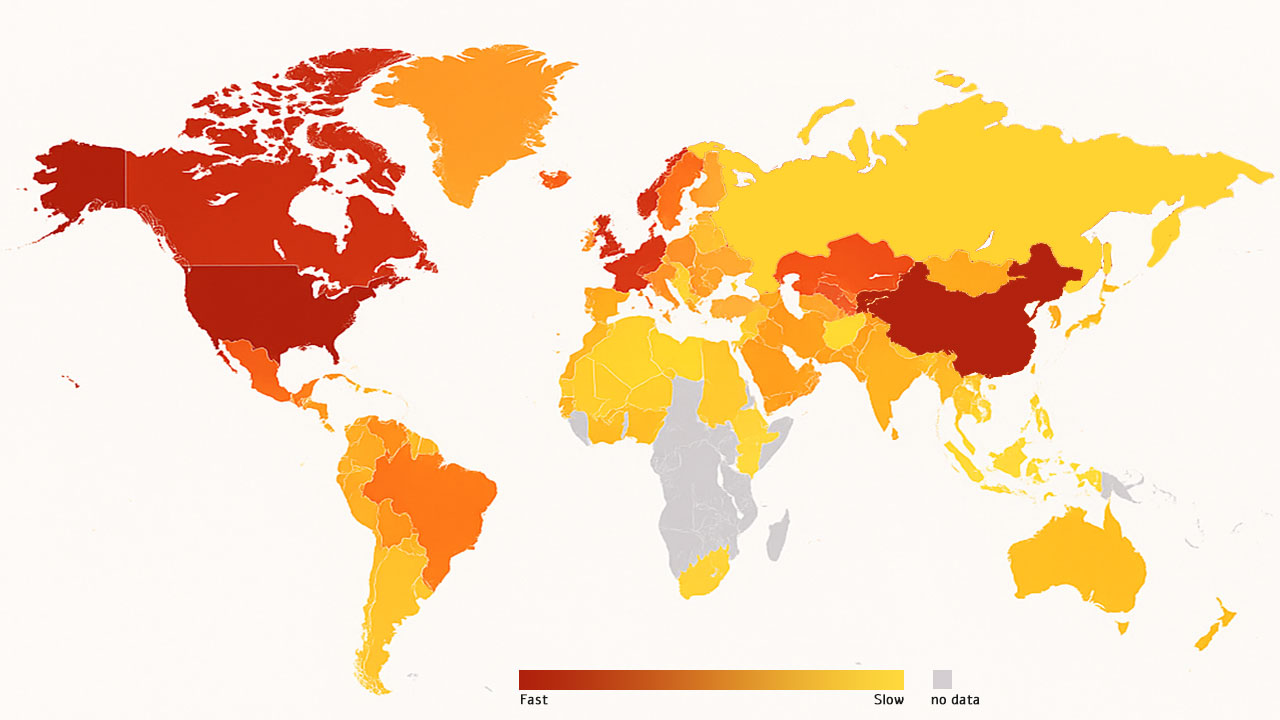
Above is the conceptual world map illustrating the speed of potential AI takeover across different regions. Countries are color-coded to reflect estimated takeover pace:
- 🔴 Swift – rapid AI integration and governance risk
- 🟠 Fast – accelerating adoption with moderate safeguards
- 🟡 Moderate – balanced development and oversight
- ⚪ Slow – limited infrastructure or regulatory delay
The AI takeover speed map was based on aggregated insights from three key sources that track global AI adoption, infrastructure, and governance readiness:
Estimation Methodology
The map reflects a composite judgment based on:
- Deployment speed (real-world AI integration across sectors)
- Infrastructure readiness (compute, data, connectivity)
- Governance and safety frameworks (policy maturity, ethical oversight)
- Investment and innovation density (startups, patents, R&D output)
Countries marked as “Swift” (e.g. U.S., China, India, UK) show high scores across all categories. “Slow” regions often lack infrastructure or policy momentum.
Country-by-country breakdown of estimated AI takeover speed, based on three authoritative sources: the AI Takeover Clock, AllAboutAI’s 2025 Global AI Adoption Report, and Stanford HAI’s Global AI Power Rankings.
🌍 AI Takeover Speed by Country (2025 Estimate)
| Region | Country | Estimated Speed | Key Factors |
|---|---|---|---|
| North America | United States | 🔴 Swift | Leading in AI investment, model development, and infrastructure |
| Canada | 🟡 Moderate | Strong research, slower deployment | |
| Mexico | 🔴 Swift | Rapid AI adoption in manufacturing and logistics | |
| South America | Brazil | 🟠 Fast | Growing AI in agriculture and fintech |
| Argentina | 🟠 Fast | Emerging AI startups, moderate infrastructure | |
| Europe | United Kingdom | 🔴 Swift | High AI research output and policy leadership |
| Germany | 🔴 Swift | Strong industrial AI and governance frameworks | |
| France | 🔴 Swift | Advanced AI regulation and deployment | |
| Poland | 🔴 Swift | Fast-growing AI sector, EU support | |
| Russia | 🟡 Moderate | Military AI focus, limited transparency | |
| Scandinavia | 🟠 Fast | Ethical AI leadership, moderate deployment | |
| Africa | South Africa | 🟡 Moderate | AI in health and education, limited infrastructure |
| Egypt | 🟡 Moderate | Government-led AI initiatives | |
| Rest of Africa | ⚪ Slow | Infrastructure and policy gaps | |
| Asia | China | 🔴 Swift | Massive AI deployment across sectors |
| India | 🔴 Swift | Rapid integration in public services and tech | |
| Japan | 🔴 Swift | Advanced robotics and AI governance | |
| South Korea | 🔴 Swift | High AI investment and education integration | |
| Southeast Asia | 🟠 Fast | Mixed adoption rates, rising investment | |
| Central Asia | 🟡 Moderate | Emerging interest, limited infrastructure | |
| Middle East | Saudi Arabia | 🔴 Swift | National AI strategy, smart city projects |
| Iran | 🔴 Swift | Military and surveillance AI focus | |
| Oceania | Australia | ⚪ Slow | Cautious adoption, strong ethics debate |
| New Zealand | ⚪ Slow | Focus on responsible AI, slower rollout |
Primary Sources Used
- AI Takeover Clock
- Offers dynamic estimates of AI’s global impact, including job automation, compute power, and ethical concern levels.
- Uses time-based modeling and public data to simulate takeover pace across regions.
- 2025 Global AI Adoption Report – AllAboutAI
- Highlights country-level AI deployment rates, with surprising leaders like China and India outpacing the U.S. in real-world integration.
- Focuses on sectors like healthcare, manufacturing, and government services.
- Stanford HAI Global AI Power Rankings
- Ranks 36 countries using 42 indicators including patents, private investment, research output, and infrastructure.
- Shows the U.S. leading in AI ecosystem robustness, followed by China and the UK.