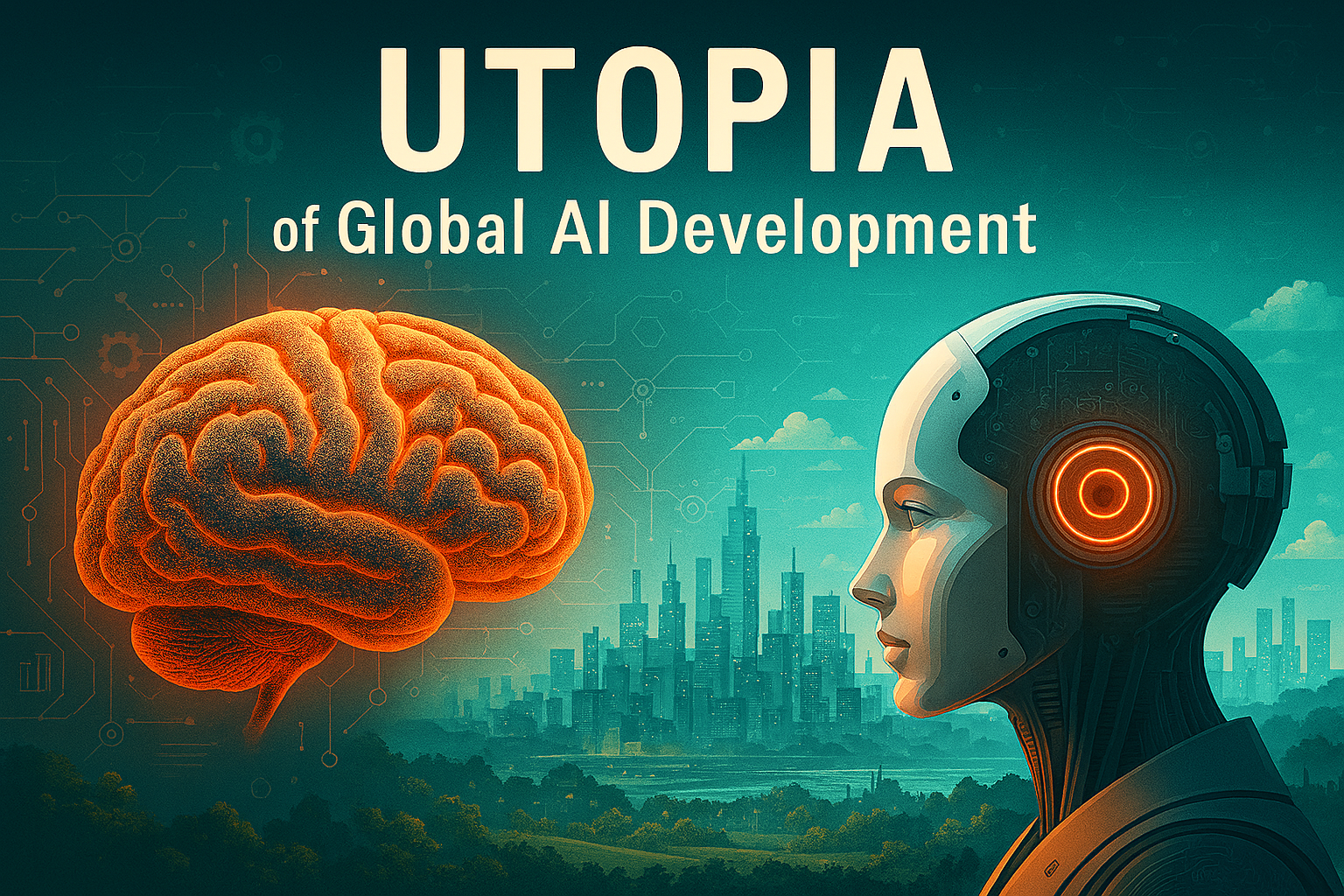
The utopian vision of global AI development imagines artificial intelligence as a transformative force that amplifies human potential, solves systemic challenges, and ushers in an era of abundance, equity, and peace. Proponents see AI not merely as a tool, but as a multiplier of cognition—akin to how engines revolutionized physical labor. Critics, however, warn that this vision often downplays structural risks and overestimates the neutrality of technological progress.
Utopian Vision: AI as a Catalyst for Human Flourishing
At its core, the utopian scenario sees AI as unlocking a post-scarcity society—where automation liberates humans from routine labor, and intelligent systems optimize everything from healthcare to climate policy. Vinod Khosla, founder of Khosla Ventures, argues that AI represents a “difference in kind,” not just degree: it multiplies human intellect, enabling near-infinite expansion of brainpower. He envisions a future where AI enables a three-day workweek, democratizes expertise, and supports aging societies by filling labor gaps.
Federico Sendra, writing for Forbes, emphasizes AI’s potential in peacebuilding and global cooperation. He highlights how AI can forecast conflicts, coordinate humanitarian aid, and facilitate multilingual diplomacy—functions that could stabilize fragile regions and reduce geopolitical friction.
In this vision, AI becomes a benevolent infrastructure: diagnosing diseases before symptoms appear, tailoring education to individual learners, and guiding policy through predictive modeling. The promise is not just efficiency, but equity—a world where intelligence is no longer scarce or siloed.
Philosophical and Economic Foundations
This utopia draws on ideas from technological determinism and computational functionalism, suggesting that intelligence—once digitized—can be scaled, shared, and directed toward collective goals. It echoes the optimism of thinkers like Ray Kurzweil, who predicts the “Singularity” as a convergence point where human and machine intelligence merge, unlocking exponential progress.
Economically, it aligns with post-capitalist theories that envision universal basic income (UBI), decentralized innovation, and AI-managed resource distribution. The assumption is that automation will decouple income from labor, allowing humans to pursue creativity, care, and exploration.
Sceptics and Critics
Critics of the utopian narrative caution against its techno-solutionism and ideological blind spots. The Stimson Center’s Red Cell Project warns that the “Techno-Utopian” vision—often promoted by billionaires and venture capitalists—minimizes systemic risks like labor displacement, erosion of human agency, and governance failure. They argue that AI’s development is being shaped more by geopolitical competition and profit motives than by ethical foresight.
Robert A. Manning and Ferial Saeed point out that Big Tech increasingly functions as a sovereign actor, reshaping society with limited accountability. They liken the current AI race to historical power grabs—where innovation masks exploitation.
Even sympathetic voices like Khosla acknowledge that the transition to utopia may be painful, especially for displaced workers. Without proactive policy—redistribution, education reform, and global coordination—the utopian promise could deepen inequality before it heals it.
Summary
The utopian vision of AI is not naïve—it’s aspirational. It imagines a world where intelligence is abundant, systems are optimized for human flourishing, and labor is redefined. But its realization depends on who builds AI, how it’s governed, and what values guide its deployment. The dream is real—but so are the risks.