- The “AI bubble” is a misnomer—what’s at risk is human expectation, not the technology itself.
AI won’t collapse like a soap bubble; instead, it’s our inflated hopes of using it as a universal business solution that may burst. The technology and its development will persist, but many companies may face disappointment when AI fails to deliver the miraculous returns they imagined. - AI’s seductive simplicity masks a dangerous illusion of autonomy.
Unlike the Mars colonization fantasy, AI feels accessible and omnipresent—like a super-tool that can fix everything. But most users don’t understand how it works. The illusion that AI “knows everything” and “won’t make mistakes” leads to risky deployments without accountability or foresight. - AI’s decision-making power makes it fundamentally different from past tech booms.
Comparisons to the dot-com era fall short. The internet doesn’t make autonomous choices—AI does. This shift introduces unpredictable dynamics, and we lack the experience to safely coexist with a non-human intelligence that can plan, act, and evolve independently.
First and foremost, we must point out how unfortunate the term “AI soap bubble” really is. Soap bubbles are defined by the fact that they inevitably burst—and there’s absolutely nothing you can do about it. But in this case, it’s not AI that will burst. What will burst are our overly optimistic hopes of installing it as the central tool for running business. AI itself—and the industry accelerating around it—will remain intact.
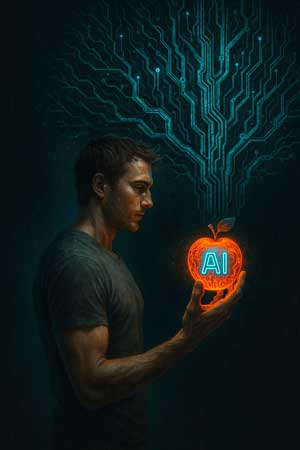 The idea of colonizing Mars, so popular among a small group of billionaires, could also be called a “Mars bubble,” if it weren’t so far removed from reality that most people don’t take it seriously, let alone invest their money in it. In contrast, artificial intelligence is a far more seductive reason to misjudge ourselves. The media frenzy surrounding the supposedly unimaginable profits from implementing AI into everything imaginable has led many people—who don’t fully understand what they’re dealing with—to feel vulnerable and left behind if AI isn’t at the heart of their marketing future.
As Olivier Gourinchas, Chief Economist of the International Monetary Fund (IMF) puts it like this:
“The promise of a new, transformative technology ultimately may not meet market expectations in the near-term and trigger a crash in stock valuations.”
So why might AI fail to deliver the fabulous financial returns expected of it? For the same reason Elon Musk’s Mars conquest project might fail. Yes, Musk’s rockets sometimes launch without exploding. Yes, they could theoretically reach Mars in six months. Yes, a colony could be built there — there’s water, apparently, and food could be grown in greenhouses. But the real question is: why? Why spend billions upon billions of dollars on a dubious adventure riddled with potentially fatal scenarios? Human imagination does its job well here, clearly telling its owner: don’t get involved — there’s absolutely no point in this for you.
AI, on the other hand, doesn’t require travel, doesn’t ask for water, and doesn’t need protection from falling meteorites. What’s more, it’s already seeping out of every crack like some universal tool — a super-mega screwdriver that can supposedly tighten every economic bolt. The problem is, almost no one really knows how to use it. People remain under the dangerous illusion that it will do everything on its own, because it already knows everything and seemingly doesn’t make mistakes.
Our website’s mission is to dispel this dangerous illusion by explaining one simple behavioral principle: if you don’t know how it works, and can’t imagine what will happen when you turn it on — don’t turn it on!
Of course, no one will listen to us, and we’re not betting on it. Adam was told not to eat the apple, too. If God had been a bit wiser, he simply wouldn’t have mentioned the apple at all — maybe Adam wouldn’t have noticed it. But walking past forbidden fruit is much harder.
One way or another, the initiators of massive capital investments into the obscure enterprise called “artificial brains” occasionally shake their heads and ask a simple question: what if it doesn’t work? What if it doesn’t deliver the expected dividends?
These concerns are well-founded. AI development has already gone so far that predicting the consequences of delegating key production and planning functions to it is no longer simple. No one can guarantee anything here, because we simply have no experience coexisting with an intelligence equal to — or even exceeding — our own. And every day, we dig deeper into Pandora’s box, trying to release this genie.
Many compare this to the dot-com boom of the 1990s. But that comparison isn’t quite accurate. The internet is multifaceted, but its key difference from AI is that the internet doesn’t make decisions. A website can’t do anything on its own—it simply processes user requests. With the internet, the relevant question is “how will the site respond to a given request or user behavior?” With AI, the question is far more complex—and we’re not even sure how to phrase it. Given AI’s growing ability to make decisions independently, it’s becoming increasingly difficult to predict how we’ll need to interact with it.
In conclusion, we advise small and medium-sized businesses not to fall for the temptation of quick riches through AI. It may well turn out to be a double-edged sword. As for big business — those clever folks probably don’t need anyone’s advice... or so they think.
The text of this article was created by real people, not AI
Sources:
- CyberNews: Revisiting the AI bubble theory
- Crunchbase: The Great AI Bubble Debate
- CNBC: Are we in an AI bubble?
- Harvard Business Review: Is AI a Boom or a Bubble?
- Finbold: Citi on AI bubble risk
- Cryptopolitan: Nokia dismisses bubble fears
- GeekWire – Cory Doctorow and Ed Zitron on the AI bubble
- Al Jazeera – IMF warns of AI bubble risk