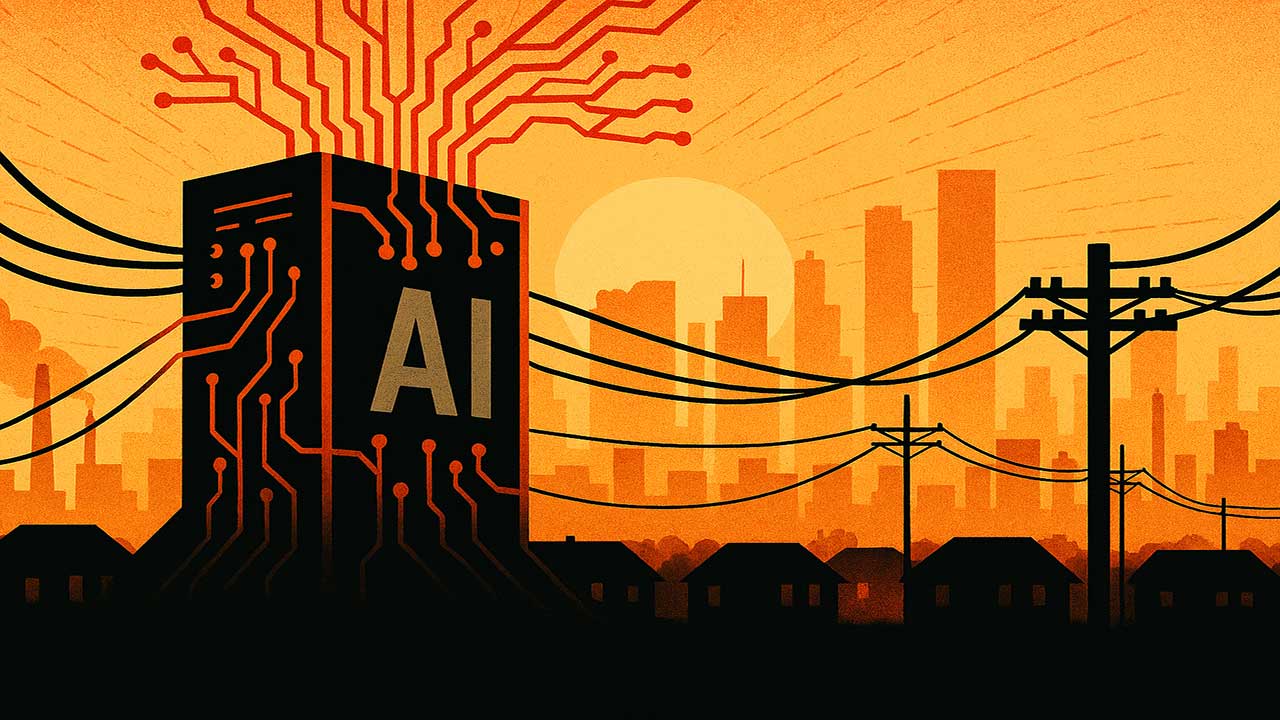
Artificial intelligence is booming — transforming industries, reshaping workflows, and redefining what machines can do. But behind the innovation lies a growing energy footprint that’s quietly reshaping utility costs, infrastructure policy, and environmental sustainability. The AI revolution isn’t just digital. It’s physical, material, and increasingly expensive.
AI may help cure diseases, solve complex problems, and reshape society. But unless we address its energy demands, the cost of innovation may be paid by everyone — in rising bills, strained infrastructure, and a planet pushed to its limits.
The Invisible Surge: AI’s Growing Appetite for Power
We rarely talk about AI’s energy consumption, but it’s becoming impossible to ignore. Tools like ChatGPT, now embedded in everyday apps and services, consume nearly 10 times more electricity per query than a standard Google search. That’s because AI isn’t just software — it’s a computational engine requiring constant processing, vast memory, and intensive cooling.
Unlike traditional software, AI models must be loaded into memory, kept active, and run on specialized hardware like GPUs and TPUs. These chips are power-hungry, and their performance scales with heat — requiring elaborate cooling systems that further increase energy demand. Every interaction with an AI model, whether it’s generating a sentence or interpreting an image, triggers a cascade of computations across data centers that span continents.
Data Centers: The New Power Hubs
AI runs on massive data centers, not small servers tucked away in office closets. These facilities demand energy on a scale that, according to Columbia University, rivals entire cities. In states like Virginia and New Jersey, where data center density is highest, electricity prices have surged — up to 267% in five years.
Virginia alone hosts over 660 data centers, more than any other state. These aren’t just tech installations — they’re infrastructural behemoths, drawing megawatts of power and reshaping local economies. The concentration of AI infrastructure has turned energy policy into a political issue. Promises to rein in utility costs helped candidates like Abigail Spanberger and Mikie Sherrill win recent elections. Governors are now pressuring PJM Interconnection — the regional grid operator for 13 states — to reduce consumer costs or risk losing state participation.
National Impact and Legislative Response
The energy spike isn’t limited to the East Coast. Missouri saw a 38% increase in electricity costs this year, followed by North Dakota, New Jersey, and Iowa. Meanwhile, federal policy is accelerating the trend: a recent bill passed by the Trump administration allocates over $1 billion for unregulated AI expansion, with few provisions for energy oversight or sustainability.
Bloomberg Intelligence projects the AI industry will grow 42% by 2030, reaching a market size of $1.3 trillion. Some experts warn this could be the largest surge in energy demand since air conditioning — but unlike AC, consumers don’t control AI’s energy use. They pay for what tech companies consume.
States are beginning to push back:
- Oregon’s Power Act helps utilities negotiate fairer deals with data centers and crypto miners, ensuring that high-consumption entities don’t offload costs onto residential users.
- Nevada’s clean transition tariff forces Google to cover 100% of its new energy costs, setting a precedent for corporate accountability.
- Pennsylvania regulators are closing loopholes in colocation agreements, which previously allowed data centers to avoid paying full grid usage fees.
These measures aim to shield low- and middle-income households from rate hikes driven by AI infrastructure — but they’re just the beginning of a broader regulatory reckoning.
AI Use Is Everywhere — and Growing
Benjamin Lee, professor of electrical and systems engineering at the University of Pennsylvania, explains that most people use AI without realizing it. Search engines, social media platforms, and digital services increasingly route queries through AI models to generate summaries, recommendations, and responses.
Historically, energy concerns focused on training AI models — processing massive datasets to build capabilities. But now, the cost is shifting to inference and deployment: the everyday use of AI by millions of users. Every autocomplete suggestion, every personalized feed, every AI-generated image or video — it all adds up.
And as AI becomes embedded in everything from smart thermostats to autonomous vehicles, the cumulative energy demand will only grow. The question is no longer whether AI consumes energy, but how much — and who pays for it.
Innovation vs. Sustainability
Lee emphasizes that the industry is still chasing the “killer app” — the transformative use case that justifies AI’s scale. Until that’s found, companies are expanding capabilities and absorbing energy costs to stay competitive.
“If a team is trying to develop a breakthrough and isn’t getting results, they don’t want to wonder whether throwing another 100 megawatts at the problem might have worked,” Lee notes.
This fear of missing out on technological advancement drives unchecked energy consumption — even as engineers struggle to optimize efficiency for a moving target. The result is a paradox: AI promises smarter systems, but its infrastructure is often wasteful, redundant, and environmentally taxing.
What Can Be Done?
Solutions exist — but they require coordination across technical, political, and economic domains. Some ideas gaining traction include:
- Dynamic pricing models for AI compute, linking energy cost to usage intensity
- Green AI initiatives, promoting energy-efficient architectures and training methods
- Federated learning and edge computing, which reduce reliance on centralized data centers
- Transparency mandates, requiring companies to disclose energy usage per model or query
- Public-private partnerships to fund sustainable AI infrastructure in underserved regions
Ultimately, the challenge is not just technical — it’s ethical. If AI is to serve humanity, it must do so without draining the resources that sustain it.